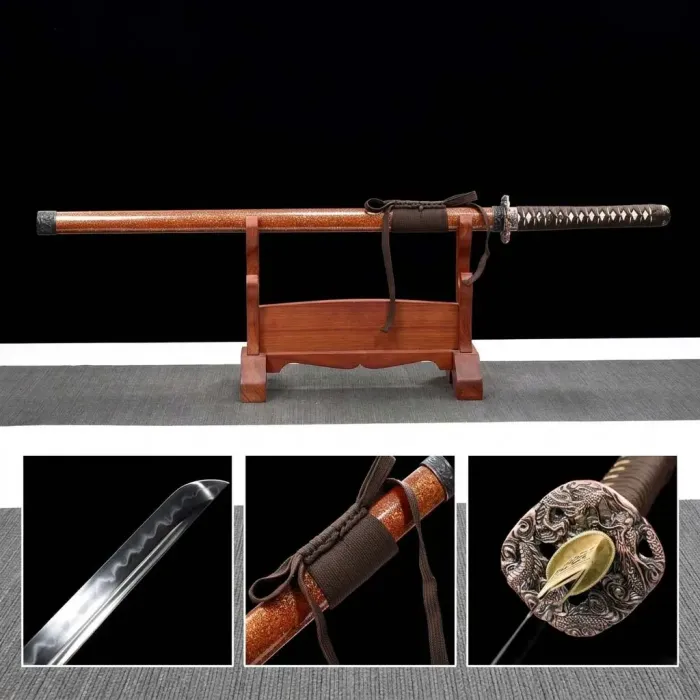
Such age-old historical sword acts as a beautiful showcase of talent, but suppose you long for to reveal your particular flair? Tailoring your blade is a significant journey, allowing you to craft a truly exceptional piece. From the grasp wrapping and collar to the barrier design and heat mark, each feature offers a chance for specialized modification. This study delves into the territory of katana refinements, providing information for both starters and knowledgeable enthusiasts seeking to set their endorsement on the heritage art of the samurai.
Newcomer's Original Mastery
For aspirants hoping to embark on the satisfying journey of traditional blade practices , 1060 steel katanas deliver an remarkable entry point. This specific grade of fundamental steel hits a optimal point between expense and effectiveness . While lacking compared to hard as leading steels, 1060 accommodates a moderate level of sharpening , making it appropriate for apprentices to enhance the groundwork of blade care and enjoy the grace of genuine Japanese weaponry. It’s a superb choice for establishing experience without the fiscal burden of more elite steels.
T Ten Alloy Sabers : Optimizing Excellence and Value
Catering to devotees seeking an authentic armament experience without overwhelming the capital constraint , T10 fabrication katanas represent a beneficial option. These instruments offer a substantial improvement in endurance compared to budget alternatives, exhibiting acceptable edge retention and adequate flexibility for basic cutting techniques. While not rivaling the exquisite characteristics of superior steels like T100 or folded iron , T10 provides a notable blend of ability and affordability , making them a popular choice for trainees and those on a small earnings .
Past the Blade : Refining Your Armament's Adornments and Tsuka
As the finished sword is undeniably the central point of a katana, truly enriching its elegance lies in the thoughtful customization of its fittings and haft . This procedure allows individuals to exhibit their individual style . Review the wide possibilities: menuki - decorative appliqués that bring visual interest ; the hamon protective covers – often carefully engraved ; the tsuka center itself, wrapped in traditional ito cord ; and the fusa pommel , which can be fabricated from various substances like treasures or antler .
- Adopt concepts that echo with you.
- Test with distinctive elements .
- Concentrate on excellence for a durable effect .
The Appeal of the Katana: Tradition, Creation, and Alloy
Such Japanese sword contains a matchless allure, steeped in epochs of oriental history and ancestry. More than merely a implement of military action , it's a figure of the bushi ethos – a fusion of dexterity and management . Its evolution spanned multiple generations, with early metallic weapons evolving into the graceful curvature and dangerous edge we accept today. The craftsmanship involved is truly astounding , requiring ages of coaching to master . The process involves a intricate folding of refined metal , creating layers that fortify the blade's flexibility and slicing ability. Diverse schools of crafting came about , each with their own secrets and methods for achieving the perfect symmetry and definition - a truly challenging pursuit.
- Former Katana forms
- The function of the nihonto in fighter culture
- Heritage blacksmithing systems
Determining the Right Steel for Your Armament Project: 1060 vs. T10
Identifying the favorable steel is essentially important for any cutlery project, and the conclusion between 1060 and T10 can be intricate. 1060 is a frequented American element, offering a competent balance of rigidity and endurance, supplying it comparatively easy to forge. However, T10, a Oriental steel, frequently boasts increased wear durability and can conceivably achieve a more ultimate hardness, although it can be somewhat difficult to apply and requires refined heat modifying. Consider your capability and preferred effects: for a newcomer, 1060 may be a more origin, while the expert smith might value the supplementary qualities of T10.
- Ease of Utilizing
- Resistance
- Definitive Durability
Revealing the Strength: Expert Katana Improvement Strategies
Honing the expertise in edge enhancement extends far beyond basic polishing. Serious professionals are now examining advanced techniques to truly unlock a blade's hidden potential. This comprises intricate work with the quenching mark, utilizing specialized materials for differential condition and carefully determining the geometry of the shield to optimize balance and effectiveness. Beyond purely functional enhancements, artisans are increasingly focused on attaining unparalleled aesthetic appeal, through complex cutting and layered surfaces that truly transform a katana into a artistic composition.
Forging a 1060 Katana: From Raw Metal to Masterpiece
The journey opens with ordinary 1060 compound , a tough material far separated the refined katana it will turn into . Skilled bladesmiths practice a complex process of integrating and constructing the unrefined steel, repeatedly tempering it and beating it to separate impurities and produce a homogeneous grain structure. This tedious process, often continuing for spans , builds the vital sturdiness and ductility characteristic of a authentic Japanese cutlery . Further heat procedures , including deliberate hardening and tempering custom katana , are essential to achieve the targeted balance of sharpness, life and charm .- Uniting: Removes impurities and develops grain structure.
- Forming: Fabricates the steel into the initial blade form.
- Tempering: Decides the final hardness and flexibility.
The Persistent Magnetism of the Katana: Thorough Examination of Alloy and Modification
That time-honored katana survives a powerful symbol for Japanese artistry , its attraction far overtopping mere arms and armor . Forged from traditional steel and often featuring intricate patterns , the technique of creation itself is a hallowed art. Beyond the primary craftsmanship, the ability to adapt a katana - from the quench mark to the shaft wrapping and fitting - provides for a honestly individual demonstration for both curators and participants alike. This confluence of classical steelwork and boundless personalization creates the katana's continued popularity across the universe.